
Infection Control, Subsidised Training
and Traineeship Pathways
Key updates to AS/NZS 5369:2023 and how to access subsidised dental assisting training.

Amendment to AS/NZS 5369:2023 — What It Means for Your Steriliser Testing
AS/NZS 5369:2023 Reprocessing of reusable medical devices and other devices in health and non-health related facilities.Amendment 1 of AS/NZS 5369:2023, removed all specific references to Bowie-Dick type tests for small steam sterilisers from Table 8.2 and section 8.7.4 and does not specify which (porous device or hollow device) should be used to meet the daily ARSPT requirement.
What Is an Air Removal and Steam Penetration Test (ARSPT)?
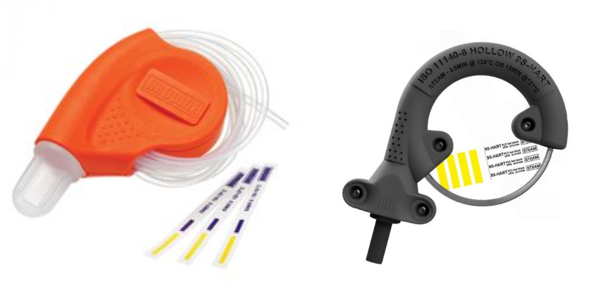
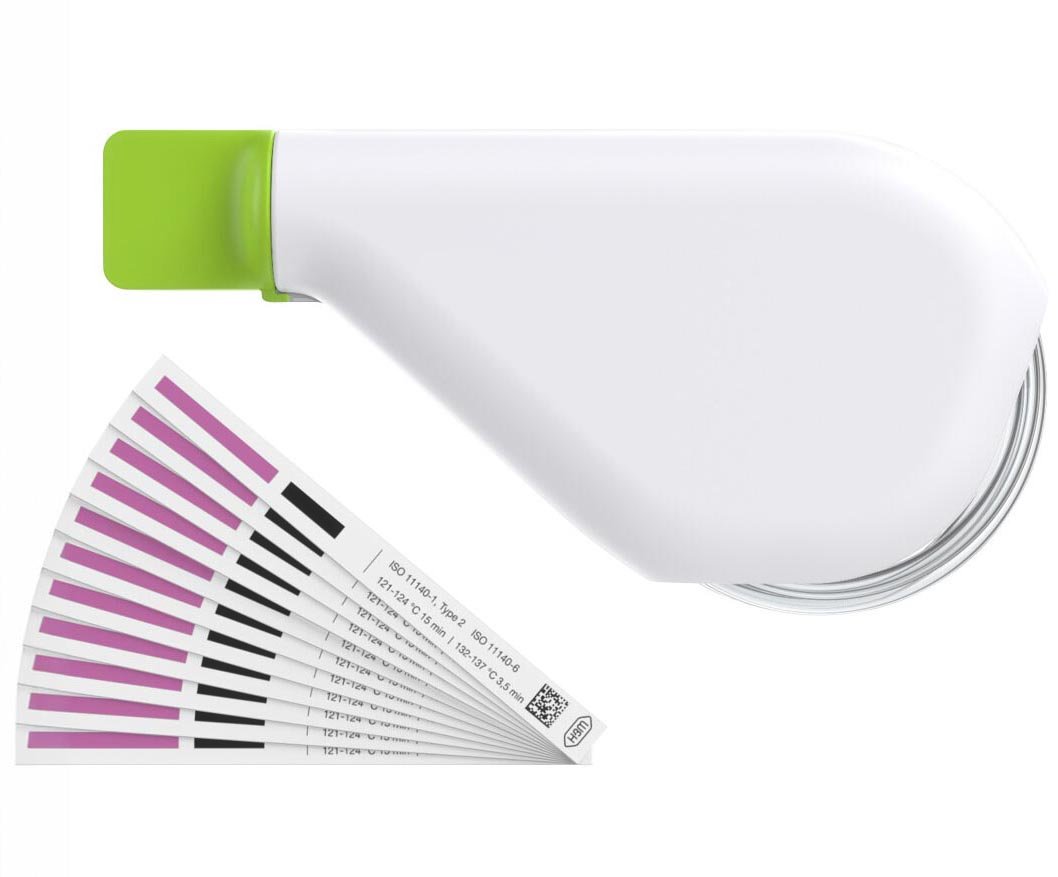
A test used to assess air removal and steam penetration in a steam steriliser. These tests may come in a variety of form factors. ARSPT for small steam sterilisers are required to conform to ISO 11140-6:2022.
The following information, adapted from the amended fifth edition of the ADA infection control guidelines, explains in detail the testing requirements for your practice sterilisers.
Steam Steriliser Performance Tests
Steam sterilisers are complex pieces of equipment and may be affected by mechanical faults; they are also prone to errors from incorrect use by operators. It is necessary to regularly monitor the sterilisation process to ensure the process has met all parameters and that the reprocessed RMDs have been sterilised.
For a small pre-vacuum steriliser which runs B cycles, a range of tests must be carried out. These tests are shown in the flow diagram below, which is a suggested workflow. In summary, after the vacuum/leak rate test is performed, an appropriate air removal and steam penetration test (ARSPT) that is compliant with ISO 11140-6 is run. Guidance on choosing an appropriate ARSPT for small steam sterilisers (either a hollow device (previously known as a helix test) or a porous device (such as a Bowie-Dick type test)) is provided in the following sections.
On the other hand, for a large pre-vacuum steriliser which runs B cycles, with a chamber size above 60 litres, the required daily tests include an ARSPT of the porous type, namely a Bowie-Dick type test. As well, a large steam steriliser requires a warmup cycle prior to commencing vacuum leak rate tests. This warmup is not needed when doing the vacuum/leak rate test for small steam sterilisers.
Leak Rate Test (Vacuum Test)
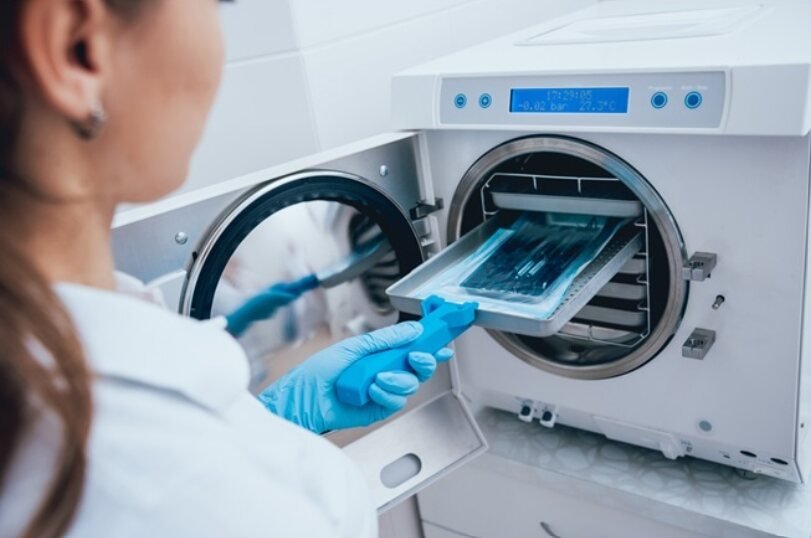
This tests the integrity of the entire system under vacuum, including the door seals and the vacuum pump, and the pipes and components between them. This test must be performed prior to commencing the first sterilising cycle of the day. A high leak rate means there is a damaged door seal or a leak in the pipes or chamber, or in the vacuum pump. If the steriliser incorporates automatic air leak detection, then this leak rate test is only performed weekly. In the absence of automatic air leak detection, this test is run every working day. It is important that each dental practice checks whether their steam steriliser has an air detection capability, since most small steam sterilisers do not have air detectors. For this reason, daily vacuum leak rate tests are the norm. For those brands of steam sterilisers that have air detectors, it is important that its proper functioning is checked. The required interval for testing the air detector should be stated in the manufacturer’s IFU. Manufacturers make special devices to check proper performance of air detectors. In the absence of documented information (e.g. from the service engineer who conducts annual calibration) that the air detector system is working properly, users should perform vacuum leak rate tests daily instead of weekly.
Tests for Air Removal and Steam Penetration for Small Steam Sterilisers
Air removal and steam penetration tests (ARSPT) come in a range of form factors (sizes and shapes). As explained in ISO 15882 section 6.4, the performance of an ARSPT is the combined effect of the chemical indicator within it, the dimensions and materials of manufacture. This is why different types of load challenges can be represented by different ARSPTs.
Table 8.2 of AS/NZS 5369:2023 requires an air removal and steam penetration test (ARSPT) to be performed daily. For small steam sterilisers, the test must be compliant with ISO 11140-6:2022.
Sterilisation of health care products – Chemical indicators – Part 6: Type 2 indicators and process challenge devices for use in performance testing of small steam sterilisers. This ISO standard includes specifications for both:
- A reference porous device.
- A reference hollow device.
Amendment 1 of AS/NZS 5369:2023, removed all specific references to Bowie-Dick type tests for small steam sterilisers from Table 8.2 and section 8.7.4 and does not specify which (porous device or hollow device) should be used to meet the daily ARSPT requirement.
There are several sources for guidance on the choice of ARSPT for small steam sterilisers. Users should initially refer to manufacturer advice (e.g. instruction manual) for guidance on what type of daily ARSPT (hollow device or porous device) is advised for that particular steam steriliser. In the absence of specific manufacturer advice, the type of ISO 11140-6 compliant test required daily should be determined based on the types of RMDs being processed, i.e. if hollow loads (lumens) are commonly included in loads, then a daily reference hollow device ARSPT should be performed. The rationale behind this is explained further in the following discussion.
Air removal is most challenging from devices that are lumened (hollow). Hollow devices could have a closed end or be double open-ended. Devices with a closed end pose the greatest challenge to air removal and steam penetration.
Based on EN13060:2014, the difficulty of air removal increases when the ratio of length of cavity to diameter is greater than 5. This ratio can be calculated, as shown in the table below. For double open-ended lumens (i.e. both ends open to the environment) the functional length is taken from the midway point, since air can be removed in both directions.
Examples of dental RMDs with a narrow lumen, internal tubes or pipes include (but are not limited to) surgical handpieces, piezoelectric ultrasonic scaler bodies, and piezosurgery handpieces.
As RMDs with a hollow lumen could be present in most dental sterilisation cycles, the recommendation for small sterilisers therefore is that the daily ARSPT should be a hollow device that conforms to ISO 11140-6.
When choosing a hollow device from the wide range available on the market, check the description for conformity with ISO 11140-6 (2022), as this means that the test has equivalent difficulty or challenge to the reference hollow device in that ISO standard.
It is important to follow the ARSPT manufacturer’s IFU regarding the correct method of using a test. The instructions for use will describe where to place the test device in the steriliser chamber. When a hollow device contains tubing made of plastic polymers rather than metal, the test device will have a restricted number of uses, and they must not be used beyond that point.
Users should check their steam steriliser instruction manual for specific advice on how to select and run the appropriate test cycle. This may be called a “helix test” cycle or a “helix/Bowie-Dick test” cycle. This cycle is shorter than a normal pre-vacuum cycle because the drying stage is much shorter.
An ARSPT is read by assessing colour change in the Class 2 chemical indicator positioned inside the device. A uniform colour change with no residual original colour remaining indicates that steam has penetrated. The results of the test are then recorded in the steriliser cycle records (as a pass or fail). There is no need to retain the chemical indicator strip.
Tests for Air Removal and Steam Penetration for Large Steam Sterilisers
Large steam sterilisers have chamber sizes above 60 litres, and their use is based on EN 285. In AS/NZS 5369:2023 Amendment 1, in clause 8.7.4 and Table 8.2, Bowie-Dick type tests are required as the daily ARSPT for large steam sterilisers.
Such tests will conform to ISO 11140-3 Class 2 indicator systems for use in the Bowie and Dick-type steam penetration test, ISO 11140-4 Class 2 indicators as an alternative to the Bowie and Dick-type test for detection of steam penetration, or ISO 11140-5 Class 2 indicators for Bowie and Dick type air removal tests, as appropriate.
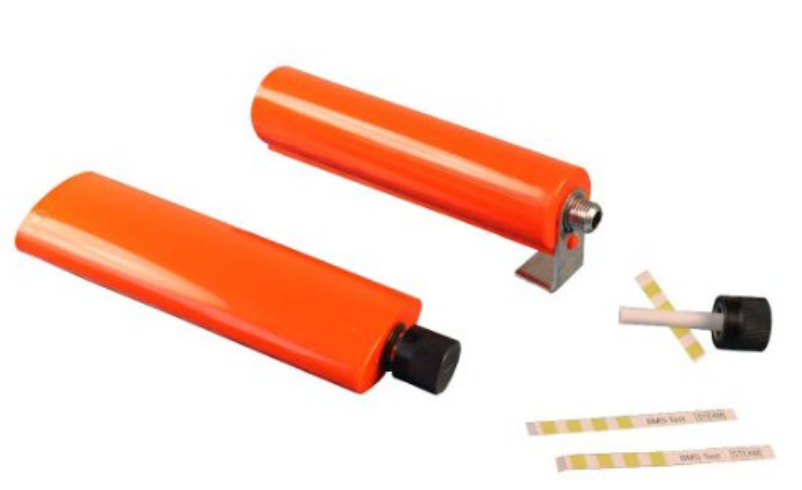
A test pack for the Bowie-Dick type test consists of two components: a small, standardised test load and a chemical indicator system to detect the presence of steam. The test load is typically presented with the indicator system already incorporated and intended for single use.
The Bowie-Dick type test must be run using an otherwise empty chamber, and with a special cycle. Staff need to check their steam steriliser IFU for specific advice on how to select and run the special Bowie-Dick type test cycle. The steam steriliser instructions for use will also describe where to place the Bowie-Dick type test device in the chamber.
At the end of the test, the indicator sheet or strip must show a uniform colour change under the exposure conditions used (134–135.5 °C at 3.15 mins with a tolerance of 5 seconds), with no residual original colour remaining. The results of the test are to be recorded in the steriliser cycle records (as a pass or fail), but the chemical indicator sheet itself does not need to be retained.
A ‘fail’ result could be due to problems with air removal (including failure of the vacuum pump or vacuum system) resulting in air and other gases remaining in the chamber and causing insufficient steam penetration onto the indicator surface.
In addition to the Bowie-Dick type test, a clinic with a large steam steriliser can also consider the additional use of a hollow ARSPT based on the nature of their load items, specifically the volume of items that have a narrow lumen. This would be an addition to, and NOT a replacement of, the daily Bowie and Dick type test.
Batch Monitoring of Cycles Using PCDs
As well as the use of a hollow device in an empty chamber as the daily ARSPT before a live load, another use for a hollow device is for batch monitoring. Their use in this way is optional and is based on a local risk assessment, as outlined in Amendment 1 of AS/NZS 5369:2023.
Batch monitoring devices do not replace the mandatory requirement to use an ARSPT in an empty chamber every day. Different types of load challenges can be represented by different process challenge devices (PCD). For example, a special PCD could be made that copies the internal design of an air turbine handpiece, for the explicit purpose of assessing air removal from dental handpieces. This would confirm the absence of residual air that could affect the attainment of sterilising conditions in the load (as per section 8.7.7. of AS/NZS 5369:2023).
Key Compliance Items for Tests for Air Removal and Steam Penetration
- Check the steriliser IFU for which cycle to select for running ARSPT tests.
- Check the steriliser IFU for advice on how to select the type of daily ARSPT to use. If not specified, choose the ARSPT based on the types of RMDs processed and/or chamber size of the steriliser.
- Run ARSPT tests immediately after the vacuum leak rate test.
- Ensure that the daily ARSPT complies with the correct ISO standard. For small steam sterilisers, choose products that comply with ISO 11140-6 (check the product labelling). For large sterilisers choose products that comply with ISO 11140-3, 11140-4 or 11140-5.
- Base any use of hollow PCDs for batch monitoring on local risk assessments.
For more information on your individual ARSPT tests suitable to your steriliser/s, contact the Training and Practice Consultancy Team for expert advice.
Email – consultancy@adaq.com.au
Subsidised Dental Assisting Training Available Through ADAQ
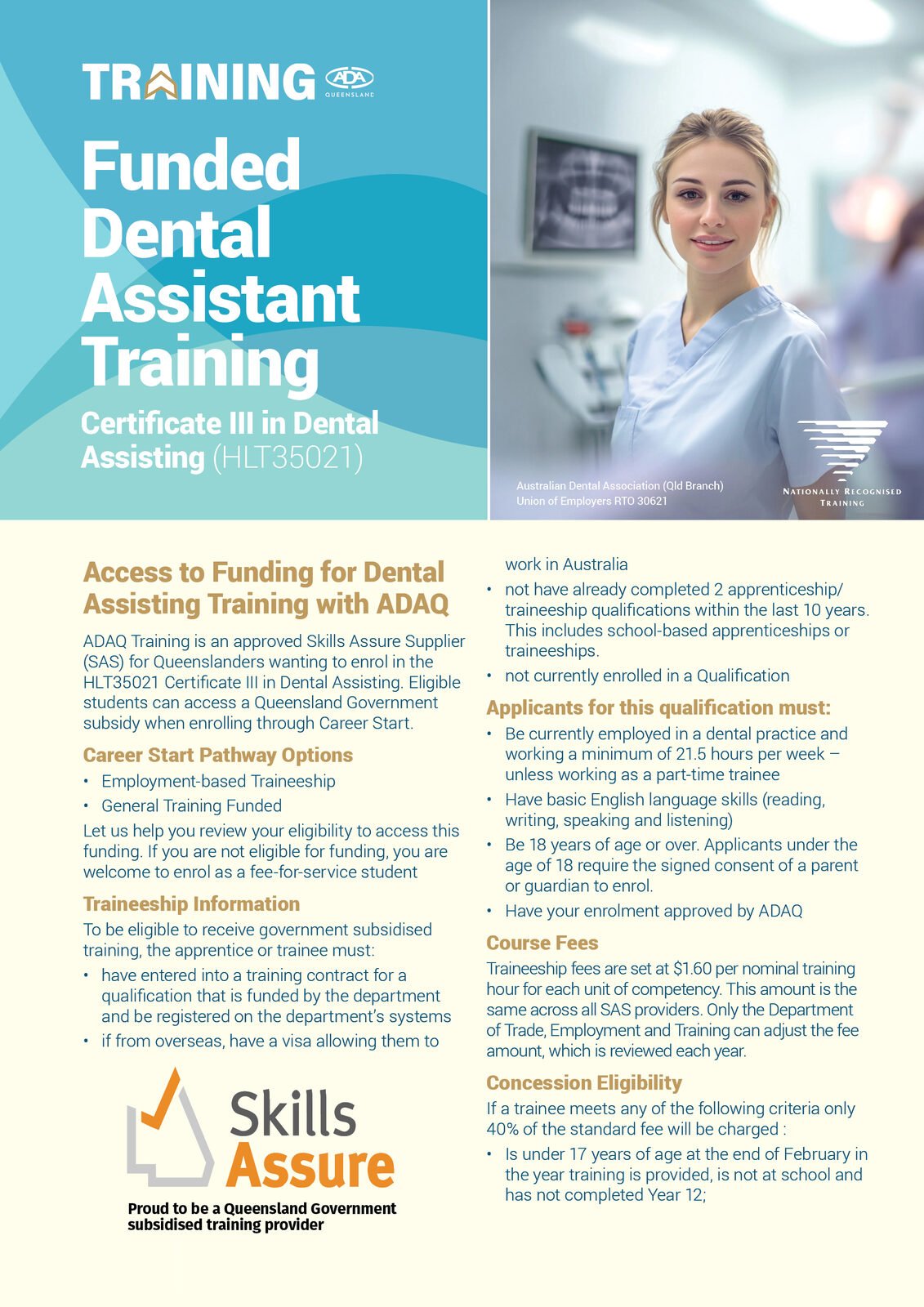
ADAQ Training continues to support Members and their teams through its role as an approved Skills Assure Supplier (SAS) in Queensland for the HLT35021 Certificate III in Dental Assisting. Through this, eligible trainees can access the qualification at a subsidised rate via the Career Start funding pathway.

Flexible Pathways to Suit Your Team
A range of pathway options are available to accommodate different practice and employment needs:
- Employment-based Traineeship
- General Training (funded)
- Fee-for-service enrolments (available for those not eligible for funding)
Practices are encouraged to review the eligibility criteria below to determine whether their dental assistant may qualify for subsidised training. For those who do not meet the requirements, fee-for-service enrolment remains a flexible alternative.

Eligibility Requirements
To access government subsidised training as a trainee, the dental assistant must:
- Have entered into a training contract for a funded qualification and be registered on the department’s system
- Hold a visa permitting work in Australia (if applicable)
- Not have completed more than two apprenticeship/traineeship qualifications in the past 10 years (including school-based pathways)
All applicants must also:
- Be currently employed in a dental practice and working a minimum of 21.5 hours per week (unless part-time trainee arrangements apply)
- Demonstrate basic English language skills (reading, writing, speaking and listening)
- Be 18 years or older (or have parent/guardian consent if under 18)
- Have their enrolment approved by ADAQ
Understanding the Costs
The co-contribution fee for apprenticeships and traineeships is set at $1.60 per nominal training hour, consistent across all SAS providers and reviewed annually by the Department of Trade, Employment and Training.
- Standard Co-Contribution Fee: $1,168
- Concessional Fee (40%): $467.20
Concession rates apply to trainees who meet one of the following criteria:
- Under 17 (as of end of February in the training year), not at school, and have not completed Year 12
- Hold (or are a dependent/partner of someone who holds) a Health Care Card, Veteran Card, or Pensioner Concession Card
- Identify as Aboriginal or Torres Strait Islander
Supporting evidence of concession status is required at enrolment.
Getting Started: Step-by-Step
Starting a traineeship is a straightforward, supported process:
- Select an Apprentice Connect Australia Provider (ACAP) to establish the training contract and confirm eligibility
- Nominate ADAQ Training (RTO 30621) as the Supervising RTO
- Once the contract is registered, contact ADAQ Training to progress enrolment
- Complete a pre-enrolment interview and employer resource assessment with ADAQ
Start Your Enrolment
Practices and dental assistants ready to take the next step can begin the process via the Career Start pathway using the link below:
Skills Assure Funding — ADAQ Training
For further information or to discuss traineeships or general training options, the ADAQ Training team is available on (07) 3252 9866 or via email at training@adaq.com.au.
By continuing to offer subsidised training pathways, ADAQ is helping practices invest in their teams while supporting the development of a skilled and confident dental workforce across Queensland.
Traineeship Pathways